
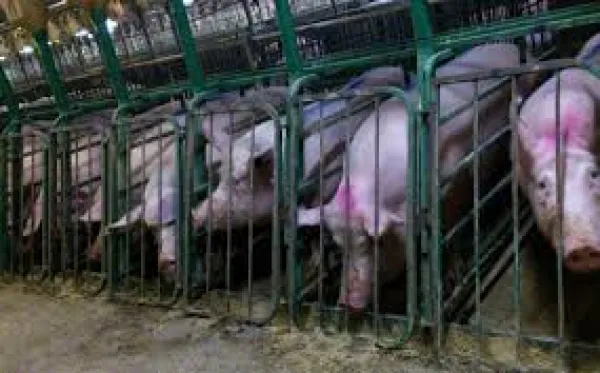
Undercover Investigation at Manitoba Pork Factory Farm, Mercy For Animals Canada, CC BY 2.0 <https://creativecommons.org/licenses/by/2.0>, via Wikimedia Commons
Modern societies often define themselves through a commitment to reducing unnecessary violence. Across law, culture, and moral discourse, the killing of humans is treated as one of the most serious ethical violations. Yet at the same time, these same societies rely on systems that produce and normalize the large-scale killing of sentient animals for food, convenience, and profit. This creates a central tension: violence is morally condemned in principle, but industrialized when directed at nonhuman life. The question is not simply whether humans should eat meat, but how a civilization that claims to reject unnecessary suffering came to organize such suffering on an industrial scale while rendering it socially invisible.
The historical condition of extraction
This tension did not emerge in isolation. The modern relationship between humans, animals, and nature was shaped by historical systems of extraction, particularly colonial expansion and industrial capitalism. European empires often treated land, wildlife, and colonized populations as resources available for control and economic use. As these systems expanded across Africa, Asia, and the Americas, they reorganized ecological relationships around production and extraction rather than coexistence.
Industrial whaling, for example, reduced whale populations on a massive scale to supply oil for lighting and industry. The ivory trade drove extensive elephant slaughter for luxury markets in Europe. In North America, the near-extermination of buffalo during westward expansion devastated ecosystems and Indigenous communities that had depended on them. The fur trade similarly transformed animals such as beavers, seals, and foxes into commodities within global exchange networks. In each case, animals were not primarily seen as living beings but as units of economic value within expanding systems of extraction.
From extraction to industrial normalization
This logic did not disappear with industrialization—it became more efficient. Modern capitalism extended these extractive systems into factory farming, where animals are raised within highly controlled environments designed to maximize output and minimize cost. In this system, animal life is reorganized around productivity, and ethical concerns about suffering are structurally subordinated to efficiency and consumption. The result is not only large-scale animal use, but the normalization of that use as ordinary economic life.
The moral asymmetry: suffering vs. species
At the center of the tension lies a basic moral asymmetry. Human societies treat unnecessary violence against humans as morally unacceptable, yet routinely accept the killing of animals despite their capacity to suffer, fear, and resist death. The justification for this distinction often rests on human exceptionalism—claims about intelligence, language, or rationality. But these criteria are inconsistently applied. Human infants, severely disabled individuals, or people in comas may lack advanced cognitive capacities, yet are still regarded as fully morally considerable. If intelligence is not the foundation of moral worth in these cases, it becomes difficult to argue that it should exclude animals from moral consideration altogether.
Philosophers have long challenged this inconsistency. Jeremy Bentham argued that the relevant moral question is not whether animals can reason or speak, but whether they can suffer. Peter Singer develops this into a critique of speciesism—the idea that privileging humans simply because they are human is a form of arbitrary discrimination. Tom Regan further argues that animals are “subjects-of-a-life” with inherent value, not merely resources for human use.
The underlying issue is therefore not intelligence, but the moral relevance of suffering.
The invisibility of violence
If the moral problem is so straightforward, the question becomes: why does the system persist? One answer lies in how industrial society structures perception. Modern consumers are largely separated from the process of animal slaughter. Meat arrives packaged, processed, and linguistically transformed. “Beef” replaces cow; “pork” replaces pig. The living animal disappears behind terminology, distance, and industrial opacity. Violence becomes socially manageable not by being eliminated, but by being abstracted.
Necessity, tradition, and their limits
Defenses of meat consumption often appeal to evolutionary history or cultural tradition. Humans did evolve as omnivores, and animal consumption has historically been part of survival in many environments. In some contexts, hunting and animal agriculture were embedded within systems of ecological restraint rather than industrial exploitation. However, these arguments become less stable under modern conditions. In industrial societies where nutritional alternatives exist at scale, animal consumption is no longer primarily tied to necessity. The ethical question shifts accordingly: not whether humans ever needed animals for survival, but whether continued large-scale suffering is justified when it is no longer required.
Health, systems, and the extension of the problem
Scientific research further complicates the necessity claim. Well-planned plant-based diets can support human health, and major nutritional bodies recognize their viability. Diets centered on plant foods are associated with lower risks of several chronic diseases, including cardiovascular disease, type 2 diabetes, and certain cancers. At the same time, industrial animal agriculture extends beyond meat alone. Dairy and egg production also rely on systematic control of animal reproduction and confinement. These systems reinforce the broader structure in which animal life is organized around efficiency rather than welfare. Environmental impacts reinforce this pattern. Livestock production contributes to deforestation, biodiversity loss, greenhouse gas emissions, and large-scale resource consumption. These are not accidental side effects but structural consequences of industrial animal production.
Moral habituation rather than direct violence
Some scholars argue that systems built on normalized animal suffering may shape broader attitudes toward violence. Research on slaughterhouse labor has associated the industry with psychological strain and trauma, while some studies have found correlations between speciesist attitudes and interpersonal aggression. However, the central issue is not direct causation. Most people who consume meat are not violent. The deeper concern is cultural habituation: when large-scale suffering becomes routine, invisible, and economically rationalized, moral sensitivity may shift—not toward overt violence, but toward indifference.
The unresolved tension
The persistence of industrial animal agriculture therefore reflects not a lack of awareness, but a structural contradiction. Modern societies claim to reject unnecessary violence while organizing systems that depend on it at scale. The result is a split moral framework: compassion is affirmed in principle, but selectively applied in practice. This is the tension that defines the issue. It is not simply about dietary preference or individual choice, but about how moral consideration is distributed within modern systems of production.
Conclusion: the structure of normalized violence
The routine killing of animals for food exposes a contradiction at the center of modern moral life. Animals are sentient beings capable of suffering, yet their suffering is systematically organized, obscured, and normalized within industrial systems that prioritize efficiency and consumption. Human civilization presents itself as committed to reducing unnecessary violence. Yet it continues to rely on forms of production that industrialize suffering at a massive scale while rendering it socially invisible. The question, then, is not whether this contradiction exists, but how long it can remain unexamined before it becomes a defining feature of modern moral inconsistency.